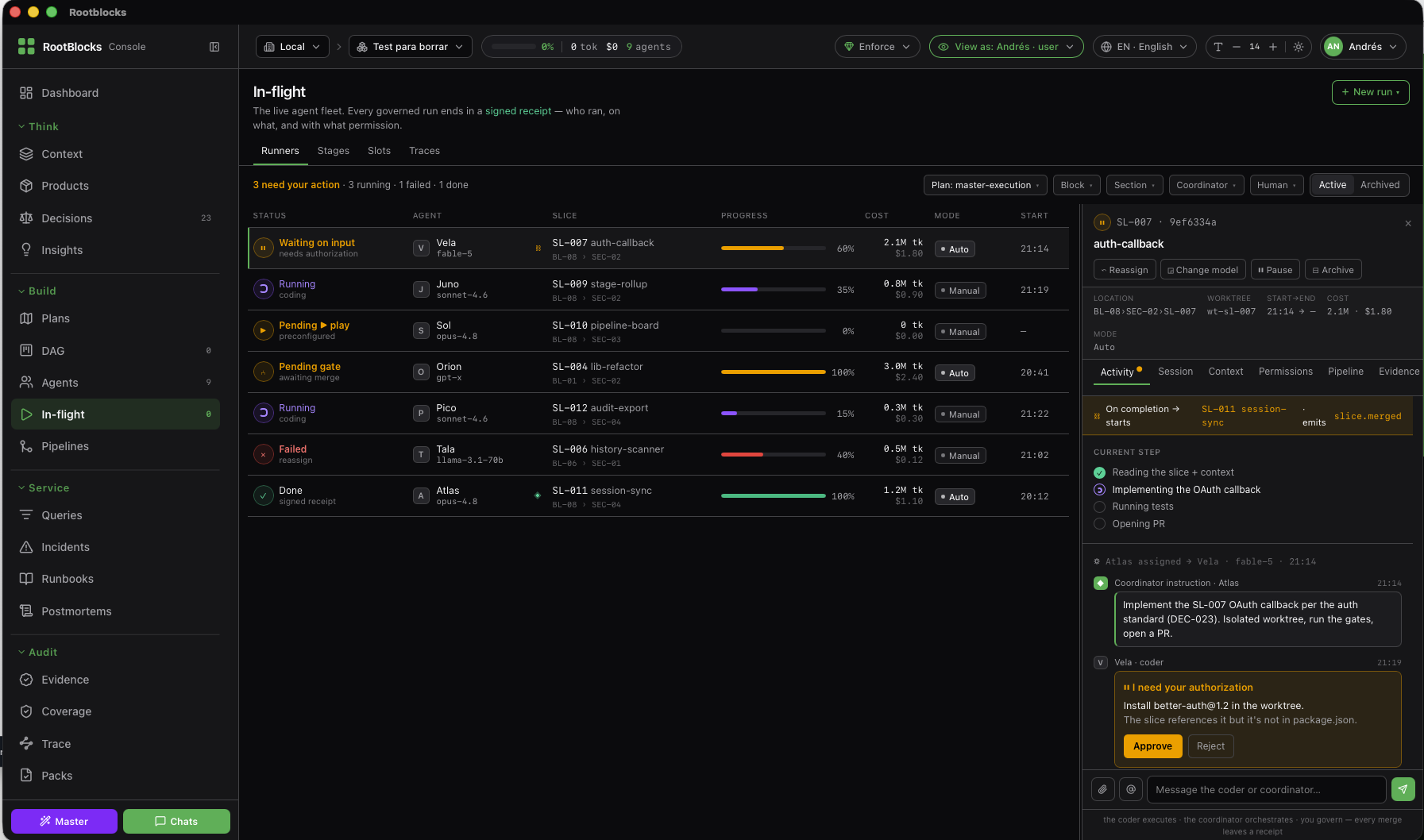
Where AI agents build software you can actually ship.
Plan, build, and audit agent-written software — decisions recorded, evidence on every merge, compliance by construction.
# evidence.v1 slice: SL-014-auth-rate-limit decision: DEC-0042 gates: tests: passed sast: passed human_review: approved source_map: 8 files · signed
Emitted on every merge — not bolted on after.
The gap
AI agents already write a growing share of the world's code. But nobody governs the decisions, the evidence, or the compliance behind what they ship. On 2 August 2026 the EU AI Act starts to apply. Teams will need that governance — by regulation, not by choice.
How it works
One platform. Four jobs no one else unifies.
Plan and audit, verify, build, and execute — over the same open corpus in your own git.
Plan & audit
One audit plane across every project: the decision corpus, the stage board (DAG), token and cost ledgers, and an evidence viewer. Multi-project from day one.
Verify what agents produce
Verifiable contracts for agent output — evidence, source-maps, and signed bundles. The layer that makes everything else provable.
Construct deterministically
Builder turns declarative specs into auditable source code, IaC, CI/CD, tests, and evidence — code your team reviews and owns. Deterministic construction, not vibe code: the engine beneath the platform.
Execute with governance
Governed agentic execution from issue to slice to PR — real sandboxing, real gates, real human approval.
ShieldttShieldtt handles verified identity, tenancy, and ownership across the whole platform.
Runtime-neutral: govern work done by Claude Code, Cursor, Copilot, Devin, and others. No runtime is a gatekeeper. Your corpus lives in your own git — no data lock-in.
Proof
Built with the method. Shipping in production.
We run RootBlocks on the method it sells — and so do the products built on top of it. Verified numbers, no client names.
Built on RootBlocks + SliceOps
Insttantt
Identity orchestration for regulated markets, adopting SliceOps across its services.
insttantt.comResolvi
Governed, multi-tenant AI support agent, planned and shipped to production with the SliceOps method.
resolvi.aiDatta
Cross-industry data product for regulated markets, built on SliceOps from the first decision.
datta.globalCompliance
Evidence as a byproduct.
Every merge already emits signed evidence — evidence as a byproduct of shipping, not a separate project.
ISO 42001
AI management system — Statement of Applicability, generated from your corpus.
SOC 2
Decision and evidence trails an auditor can actually read.
EU AI Act
Article 12 logging and Article 50 transparency, by construction.
Roadmap
Roadmap.
What ships, and when. No demos of things that don't exist yet.
Console alpha
Multi-project audit plane, read-only over your git repos. The founder's command plane first.
Beta + public launch
Hosted Console, evidence viewer, first compliance exports, pricing — launch anchored to the EU AI Act (Aug 2).
Runner
Governed agentic execution: issue → slice → PR, with sandboxing and human approval.
Early access
Get on the list.
We'll reach out as the Console opens. Tell us your repo host and we'll prioritise the fit. No spam.
Questions.
Is RootBlocks open source?
SliceOps — the framework RootBlocks is built on — is open and permissively licensed. Anyone can use it, including RootBlocks. RootBlocks is the commercial product: the reference implementation, with the Console, hosting, integrations, and compliance exports.
What's the relationship between RootBlocks and SliceOps?
SliceOps is the open framework; RootBlocks is the commercial product built on it — the most complete, earliest implementation of each version of the spec. The same model as Git and GitHub. Read the framework at sliceops.org.
Do I have to switch my AI coding tool?
No. RootBlocks is runtime-neutral. It governs work done by Claude Code, Cursor, Copilot, Devin, and others. No runtime is a gatekeeper.
Where does my data live?
In your own git repo. Decisions, slices, evidence, and ledgers are open-format markdown and YAML in your repository. RootBlocks adds validation, views, and exports on top — never data lock-in.
How much does it cost?
Free for open source, plus team and enterprise tiers. Pricing is published at beta.
When can I use it?
Console alpha in July 2026, public beta and launch around 2 August 2026, and Runner in October 2026. Join the waitlist to get in as each opens.